Marathon Pacing Strategies


Marathon Split Calculator
49/51 Effort Ratio Strategy
Please enter a valid marathon time.
First Half (13.1 mi)
49% EffortSplit Time
--:--:--
Avg Pace
--:-- /mi
Second Half (13.1 mi)
51% EffortSplit Time
--:--:--
Avg Pace
--:-- /mi
When we talk about running a marathon, we throw out a lot of discussion about how to pace one. We’ll talk about the best way to do it as if all you have to do is plug the goal pace into your watch and manifest it into existence. The reality is that optimal marathon pacing strategy is very hard to execute properly. On top of that, the right strategy might be completely different depending on where you are, the course, the time of year, etc. So, telling someone to just go out and do this or that can do a runner a big disservice. The goal of this guide is to show you what the primary options are so that you can make a better plan that is more likely to be met on race day, instead of trying to force a plan that may be doomed from the start.
Different Strategies
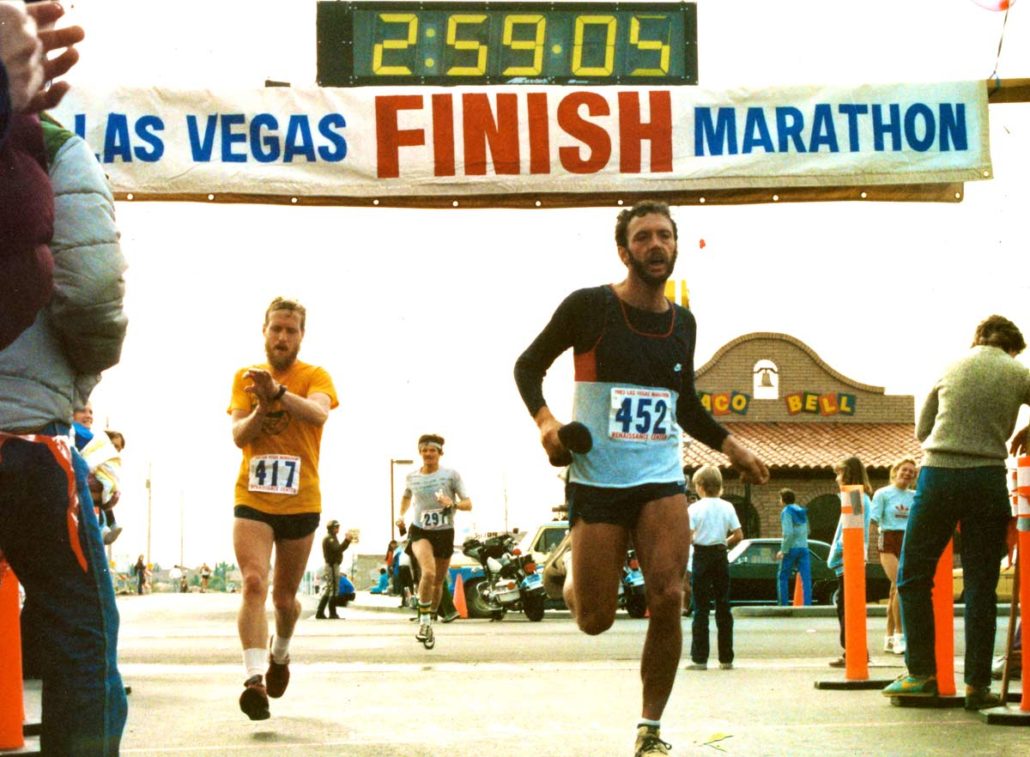
For me, I look at marathon pacing and break it into three basic strategies. The first is the even split, which means that you run your first half and second half as equally as possible. I consider anything within 2-4 seconds per mile of overall goal pace to be even paced. For example, I just had an athlete run the Chicago Marathon in 3:00:44. His first half was 1:30:06 and his second half was 1:30:38. So his second half was 2.9 seconds/mile slower than his first half (and honestly, that difference came between 35- 40 km).
The second strategy is the negative split, which is probably the unicorn of strategies. This just means that the second half of the race was faster than the first half. The vast majority of world records have been set this way, but it requires really knowing yourself and your capabilities. In theory, it’s the easiest, because you could just go out really slow and then pick it up. However, to balance that fine line of leaving just enough in reserve to pick the pace up over the last few miles is incredibly difficult.
The third strategy is the positive split, and the most common of strategies, or outcome might be a better term, for most runners. This is where the second half of the race is slower than the first half. It’s not really a strategy if you just say, “Today’s the day, full send,” only to pay the price in the last 10 miles. That’s a choice, but not a strategy! What I am talking about is a controlled effort, knowing that circumstances will cause me to slow down (not bonk) over the latter part of the second half of the race. That’s where we will put more focus in this guide.
The Even Split
What makes the even split so tough is that effort will not match pace later in the race for a lot of people. When you look at physiological responses, we look at cardiac drift, or aerobic decoupling. This just means that over time, the heart rate starts creeping up even though the pace stays roughly the same. You really have to balance a razor-thin line between being too conservative and going out too fast- and even a few seconds per mile can do this for highly trained athletes. You also have to be biomechanically sound, with being strong enough for your muscles to take the punishment and not break down to the point where they can no longer handle the pace. You will get to a point where you feel you are working substantially harder to run the same pace and will have nothing to do with fueling or hydration (in this sense anyway), it will just be the body not being able to keep up with the demand being placed on it. What it will require is a person to mentally stay strong late in the race and find a way to overcome that urge to want to slow down. Now, if you feel that way at 15-16 miles in the marathon, you simply either didn’t fuel right or overestimated your capabilities. But if you are getting to 21-22 miles and beyond with this urge to start slowing creeping in, then you did a pretty good job of choosing the pace. But we all get to that point where, mentally, we have to pull every trick out of the bag to override that urge to slow down.
Given that, the even pace is an awesome way to go about it. Even for a course like Boston, an even pace (within reason) will yield much better results than if you go out too fast. However, I believe that you also need to have certain criteria to make this happen. I will say that it is probably going to be harder for inexperienced runners, especially those with lower overall training volume. If you don’t supplement volume with some strength training, I think it becomes even harder to do. Ultimately, what will cause you to slow down, even if the pacing was reasonable and your fueling strategy solid, is the breakdown of muscle fibers, which will then cause form and biomechanical breakdown. I don’t know if you would full-on hit the wall in this case, but you will definitely lose time. You also need to be able to exert a certain amount of patience. If you look at your own training, especially long runs and long marathon-pace workouts, and see a disconnect in the second half of these workouts, then even pacing is going to be a struggle for you. On the flip side, some people just settle into a rhythm and just lock in that pace. So, overall, I think intermediate runners who have a solid volume of training, are patient, and are physically stronger will do the best with this strategy. The key will be knowing your limits, having a good correlation to how your body feels and reacts to different efforts, and not getting caught up in early excitement.
The Negative Split
This is really an extension of what I discussed with the even pacing. All of that applies here, too. My experience with athletes has been that these occurred when they were more fit than they gave themselves credit for. Maybe they were just trying to break 4 hours in the marathon, but were able to train at 3:45 pace without issue. Or they just let the race come to them. They backed off the pace group, and then everyone came back to them over the last 10k of the marathon. This can be huge mentally and really build the confidence to override the feeling of not wanting to do this anymore! It just often seems to come down to circumstances- the right things happening at the right time. That is a bit of an undersell; I understand. You have to be in that kind of shape to be able to execute that kind of plan, but ultimately, things usually need to line up for you, too. However, the same characteristics apply here too. You are more likely to implement this if you are strong, patient, and well trained with the volume and work necessary to sustain the overall muscle damage that you will incur. Being mentally strong here is an absolute must.
The question becomes, how much we can give up during the first half, but still give us a shot at our goal. I don’t know if you are going to do a 5-10 minute negative split. But I have seen people make up 1-3 minutes on a regular basis. This works well for those who are fast enough that marathon pace is a high percentage of their lactate threshold. It backs it off just enough in the first half so that they can really push the last 10k and make up all that time. Basically, the race is over before things fall apart.
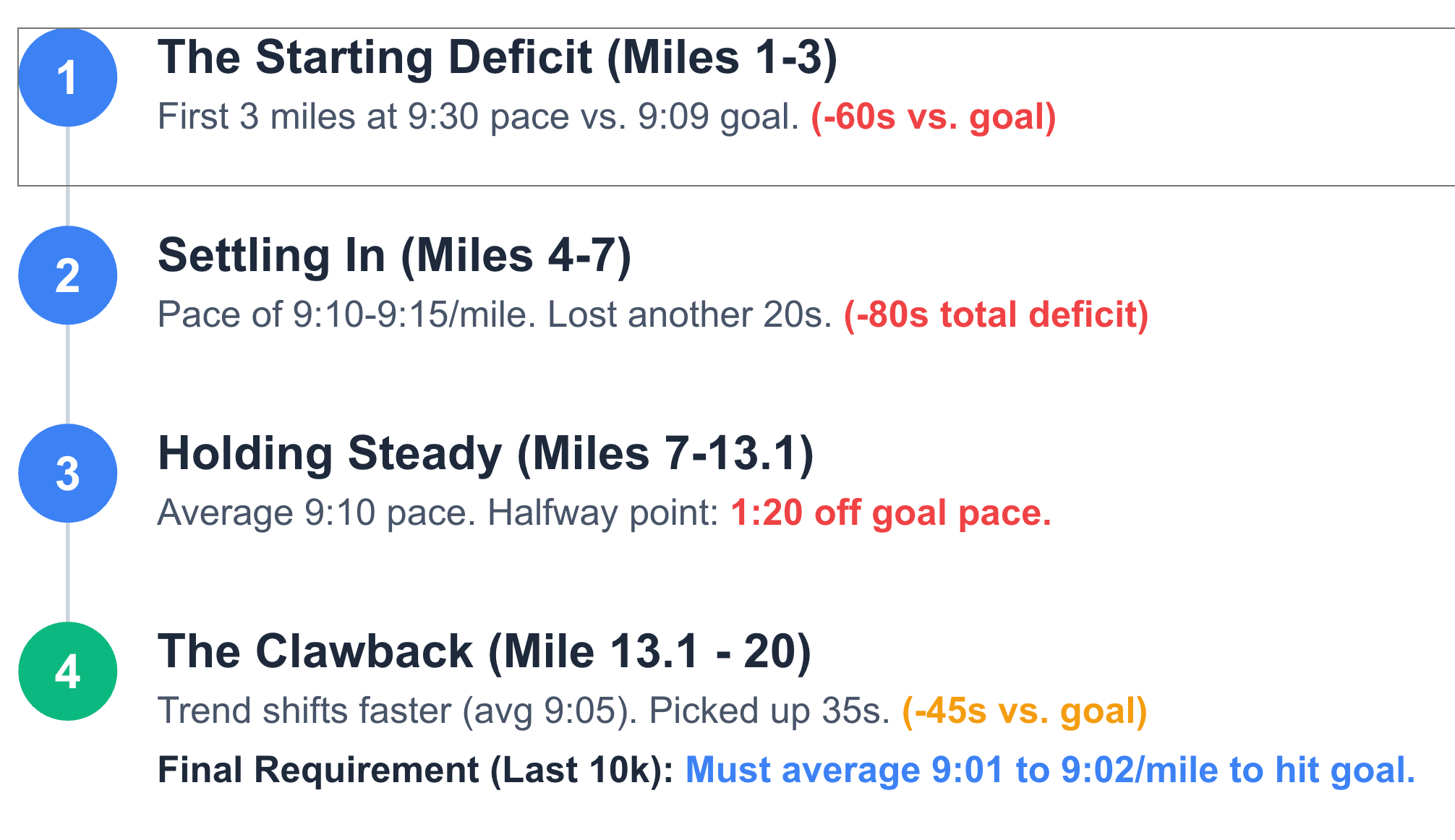
How might you go about approaching a negative split in the marathon? Here is an example of an attempt at 4:00:00
The Positive Split
This is the typical unplanned strategy for a number of reasons. I don’t want to talk about bonking here. That’s an issue of some sort of going out too fast, not fueling enough, not adjusting for weather, or any form of combination of things. This is about controlling how much you fade based on a good plan that is within reason. Like I said, even and negative split running is hard, and for the same reasons, it makes the controlled positive fade a much more likely outcome for the average marathoner. If you are a newer runner, a lower-mileage runner, and tend to go out just a touch faster than you should, you’ll probably end up in a positive fade. Instead of trying to enforce a strategy that isn’t going to be conducive to your situation.
I have seen a ratio of 47/53 put out there by popular coaches. That means the first half of your race should be 47% of your time, and the second half should be 53%- in other words, go out faster than goal pace and hope you hang on the second half. If you are trying to run 4 hours, that means your first half should be in under 1:53, and your second half should be under 2:07. Personally, I look at that and think that will be brutal. On the front end, that’s faster than a lot of those same runners have run for an open half marathon, let alone run that and then run the same distance again. On the back end, that means each mile is significantly slower than in the first half. Realistically, it’s not like that person will hit the halfway point and naturally slow to that necessary second-half pace. If they feel even remotely good, they will continue on with the original pace as long as they can. So, when it starts going bad, it’s going to go really bad. I just don’t feel like that sets the person up for a good experience.
I would rather see a person approach the positive split in a 49/51 ratio. I feel like this allows a runner to settle into a natural pace that isn’t so destructive that they cannot maintain it. You will be fresh, and it gives you some leeway to be a little faster than goal pace, but you should find yourself in a natural rhythm. Also, once you get to halfway, you’ll probably be more likely to continue on with this pace, but instead of being 40 seconds a mile faster than goal pace, you’ll be about half of that, so the deficits shouldn’t be devastating. I feel like this leads you into a more natural decline instead of just rocking till the wheels fall off. If you are good with fueling and hydration early, then this should be a gradual loss of time. By that, I mean instead of losing 60+ seconds a mile over the last 10k, you may only lose 20-30 seconds a mile and mentally be in a position where you can still be in some control of what is going on around you. You are just taking into account the gradual muscle damage the marathon will bring as the race goes on. If this works out, it also gives you a good indicator of what to work on in the future- sustained weekly volume and overall strength training. Volume increases will increase resiliency, but if you strength train first, you can probably handle the build-up of volume better. This is a good strategy for increasing temps on the course, too. How many times will a race start off in pretty solid conditions, but deteriorate by the time you are in the second half? I am not saying this will negate losses to heat and humidity, but you can use it to bank just a little bit of time, knowing you’ll start losing it as temps increase. This just makes early fueling and hydration even more important during the cooler part of the race.
Overall, I’d say this is best for specific situations for more advanced runners, but a very manageable and practical strategy for new-to-intermediate runners who are not high volume and/or don’t do strength training- especially if you have a history of extreme muscle damage post longer races.
Wrapping Up
Hopefully this helps you dial in a specific strategy for your own needs that will play to your strengths as a runner and allow you to create a strategy that is practical and something you will actually adhere to! Take your training and look at it; be honest with yourself. If you look at those long runs and you see big changes over the second half of your long runs and marathon pace workouts, then you know you have to adjust for that. If you know you kinda find your rhythm and it’s hard to shift out of that, then you know a negative split would be pretty hard. This is how you take data and make it practical. Are right- set about taking a look, creating a plan you like, and commit!